


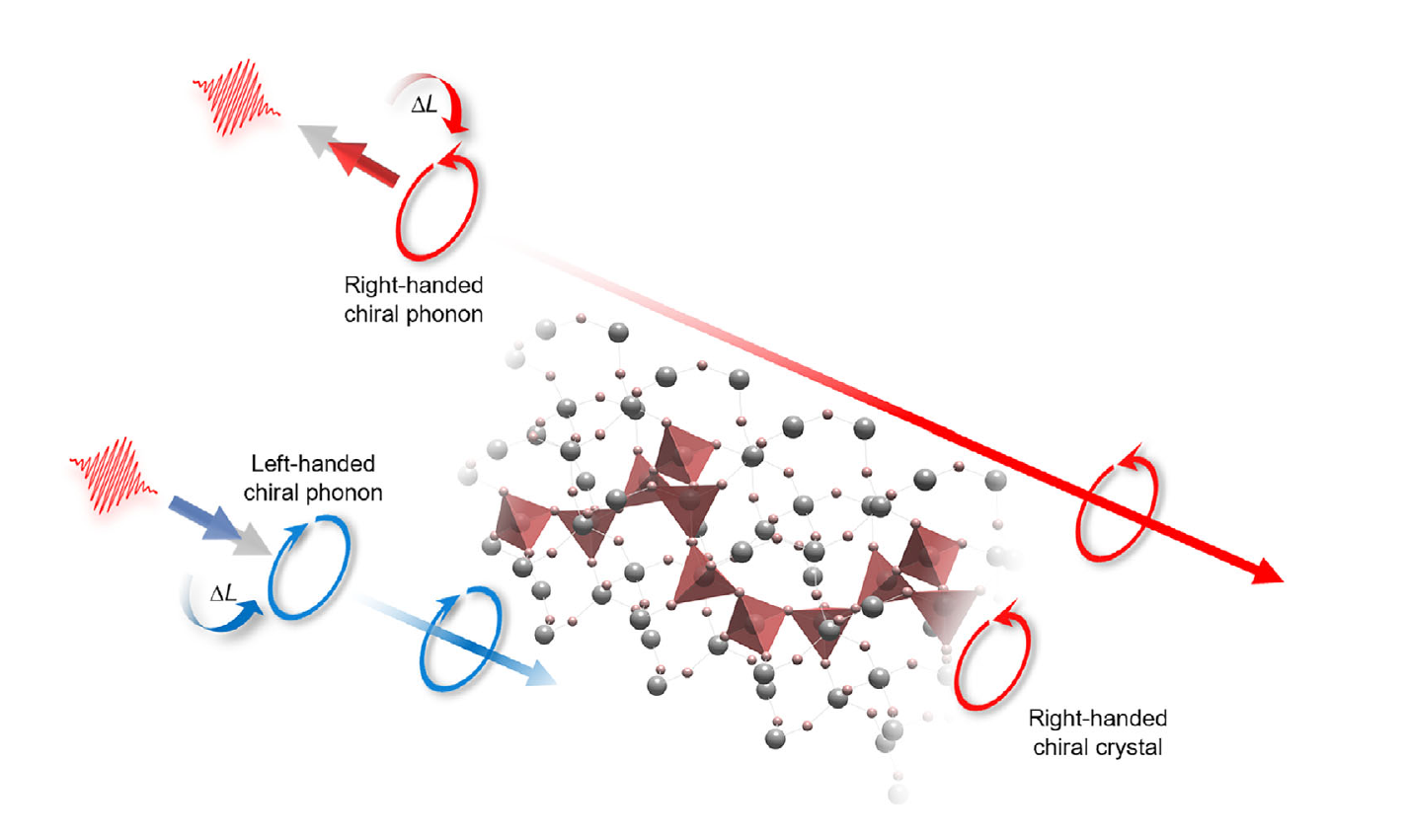
▲ 자성 박막과 카이랄 석영에서의 열수송 개념도. 레이저로 유도한 탈자 과정에서 스핀의 각운동량이 격자 진동으로 전달되며, 포논의 회전 성향과 석영의 손잡이성에 따라 열수송 효율이 달라진다. 자화 방향을 바꿔 이 선택성을 제어할 수 있다.
GIST 물리·광과학과 이종석·신동빈 교수 연구팀은 한국표준과학연구원과 공동으로, 자성의 방향과 결정의 ‘손잡이성’에 따라 열수송 효율이 달라지는 현상을 확인했다. 공동 제1저자인 최인혁·김대헌이 참여한 이번 연구는 코발트·백금(Co/Pt) 자성 다층박막과 카이랄 석영을 결합해, 전기 절연체에서 열을 운반하는 격자 진동인 포논의 회전 성향을 활용한 열 제어 원리를 제시했다. 연구 결과는 2026년 10월 13일 국제학술지 Advanced Materials에 온라인 게재됐다.
왼손과 오른손처럼 거울상이어도 겹쳐지지 않는 구조적 성질을 카이랄성이라 한다. 연구팀은 레이저가 자성 박막의 자화를 순간적으로 감소시키는 탈자 과정을 통해 회전 성향을 띤 포논을 유도하고, 자기광학 측정과 열확산 모델 분석으로 계면 부근의 유효 열전도도를 구했다. 자화 방향을 반대로 바꾸면 유효 열전도도가 상온에서 약 7%, 50 K에서 약 20% 차이를 보였다. 석영의 손잡이성을 뒤집으면 변화 방향도 반전됐으며, 카이랄성이 없는 비정질 산화규소에서는 유의미한 차이가 나타나지 않았다.
제일원리 계산으로 학습한 기계학습 원자간 힘장과 분자동역학 시뮬레이션도 포논의 회전 성향에 따른 열전파 차이를 뒷받침했다. 저온에서 효과가 커지는 결과는 포논 간 산란 감소에 따른 해석과 일치했다. 이번 성과는 스핀의 각운동량을 격자 진동의 열수송으로 연결하고, 전기적 절연을 유지하면서 열 흐름을 조절할 새로운 소재 설계 방향을 보여준다. 향후 계면과 소재를 최적화해 제어 폭을 높이는 연구로 확장할 수 있다. [Advanced Materials, IF= 29.1, JCR 1.8%]
A GIST team led by Professors Jong Seok Lee and Dongbin Shin, in collaboration with the Korea Research Institute of Standards and Science, demonstrated heat transport that depends on both magnetization direction and crystal handedness. With In Hyeok Choi and Daeheon Kim as equally contributing first authors, the study combines ferromagnetic cobalt/platinum multilayers with electrically insulating chiral quartz. Published online in Advanced Materials on 13 October 2026, it establishes a platform for controlling heat transport through chiral phonons: lattice vibrations that carry angular momentum as well as energy.
Laser excitation induces ultrafast demagnetization in the magnetic multilayer, allowing spin angular momentum to be transferred to lattice motion. Using magneto-optic thermometry and thermal diffusion modeling, the researchers extracted an effective thermal conductivity reflecting transport near the interface. Reversing magnetization produced differences of approximately 7% at room temperature and 20% at 50 K. The response reversed with quartz handedness, whereas nonchiral amorphous silica showed no significant magnetization dependence.
Molecular dynamics simulations using a machine learning force field trained on first-principles calculations supported the chirality-dependent propagation of heat. The stronger response at lower temperatures was consistent with reduced phonon–phonon scattering. These findings connect spin angular momentum with phonon-mediated heat transport and suggest a route toward thermal control in electrically insulating materials. Further interface engineering and material optimization could increase the presently modest switching contrast. [Advanced Materials, IF= 29.1, JCR 1.8%]
Authors: In Hyeok Choi, Daeheon Kim, Yeon Jong Jin, Seungmo Yang, Tae-Seong Ju, Changsoo Kim, Chanyong Hwang, Dongbin Shin, Jong Seok Lee
Equal first authors: In Hyeok Choi and Daeheon Kim.
Corresponding authors: Dongbin Shin and Jong Seok Lee.