


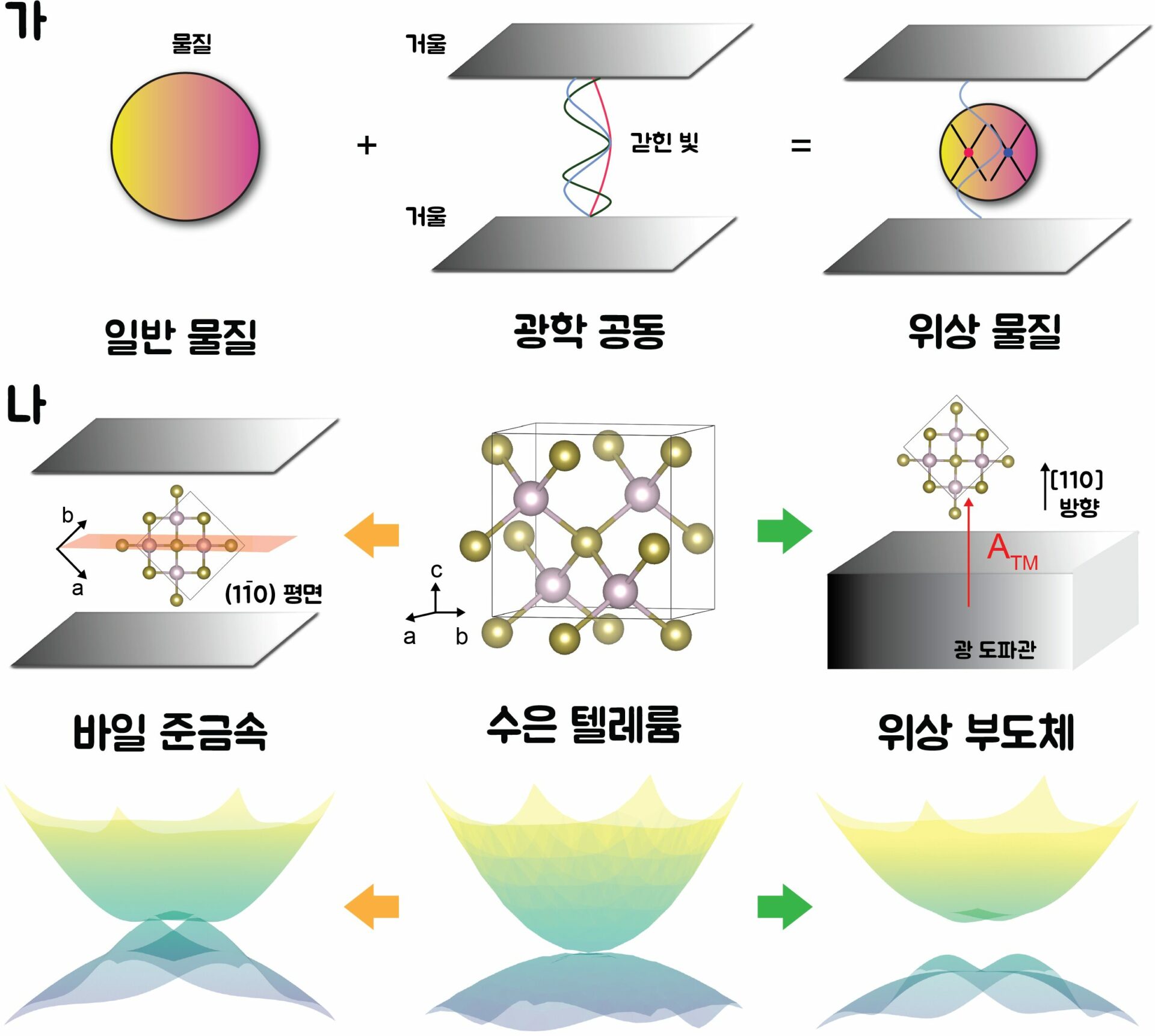
▲ 광자장에 의해 유도된 HgTe의 위상 상전이 모식도. (가) HgTe의 위상 상전이를 나타낸다. 아주 작은 거울 상자(광학 공동) 안에 빛을 가두면 물질과 빛이 강하게 얽히면서 서로 영향을 주고받게 된다. (나) 기존에는 위상 성질이 없는 평범한 금속에 가까운 물질인 HgTe가 빛의 편광 방향을 어떻게 맞추느냐에 따라 전혀 다른 위상 물질로 변하게 된다.
신동빈 교수와 독일 막스플랑크 연구소 공동연구팀은 광공동(optical cavity) 및 도파관(waveguide)과 같은 광자 구조 내에서 발생하는 강한 빛-물질 상호작용을 활용해 양자 물질의 위상학적 상(topological phase)을 능동적으로 조절할 수 있음을 이론적으로 규명하였습니다. 특히, 광자 구조 내에서 형성되는 광자장(photon field)이 편광 매개 대칭 깨짐(polarization-mediated symmetry breaking) 메커니즘을 통해 고체 내에 새로운 위상학적 상을 유도할 수 있음을 제시하였습니다. 최신 양자전기역학 밀도범함수이론(QEDFT) 계산을 통해, HgTe의 전자 구조와 이온 구조가 강한 빛-물질 결합에 의해 재구성되며, 시료의 결정 방향과 결합 세기에 따라 Weyl 상, nodal-line 상, 위상 절연체 상이 선택적으로 나타날 수 있음을 입증하였습니다. 이는 레이저 구동 현상과 달리 정상상태(steady-state)의 광자-물질 혼성화에서 비롯되는 효과로, 견고한 다수의 위상학적 상이 동시에 구현될 수 있음을 보였습니다. 본 연구는 광자 구조 내 진공 요동(vacuum fluctuation)을 이용해 물질의 특성을 설계하고, 양자 물질에서 풍부한 위상학적 현상을 온디맨드(on-demand) 방식으로 구현할 수 있는 새로운 패러다임을 제시하였습니다. [Science Advances, IF: 12.5]
Professor Dongbin Shin, in collaboration with the Max Planck Institute in Germany, has theoretically demonstrated that strong light–matter interactions in photonic structures—such as optical cavities and waveguides—can be exploited to engineer topological phases in quantum materials on demand. The team showed that photon fields confined in photonic structures induce emergent topological phases in solids through a polarization-mediated symmetry-breaking mechanism. Using state-of-the-art quantum electrodynamic density functional theory (QEDFT) calculations, they demonstrated that strong light–matter coupling reconfigures both the electronic and ionic structures of HgTe, selectively driving the system into Weyl, nodal-line, or topological insulator phases depending on the sample orientation and the coupling strength. In contrast to laser-driven phenomena, the photon field–induced symmetry breaking originates from steady-state photon–matter hybridization, enabling multiple robust topological states to coexist. The study establishes that vacuum fluctuations in photonic structures can serve as a versatile tool to engineer material properties and realize rich topological phenomena in quantum materials on demand. [Science Advances, IF: 12.5]
Authors: Dongbin Shin (FA, CA), I-Te Lu, Benshu Fan, Emil Viñas Boström, Hang Liu, Mark Kamper Svendsen, Simone Latini, Peizhe Tang(CA), and Angel Rubio (CA)